

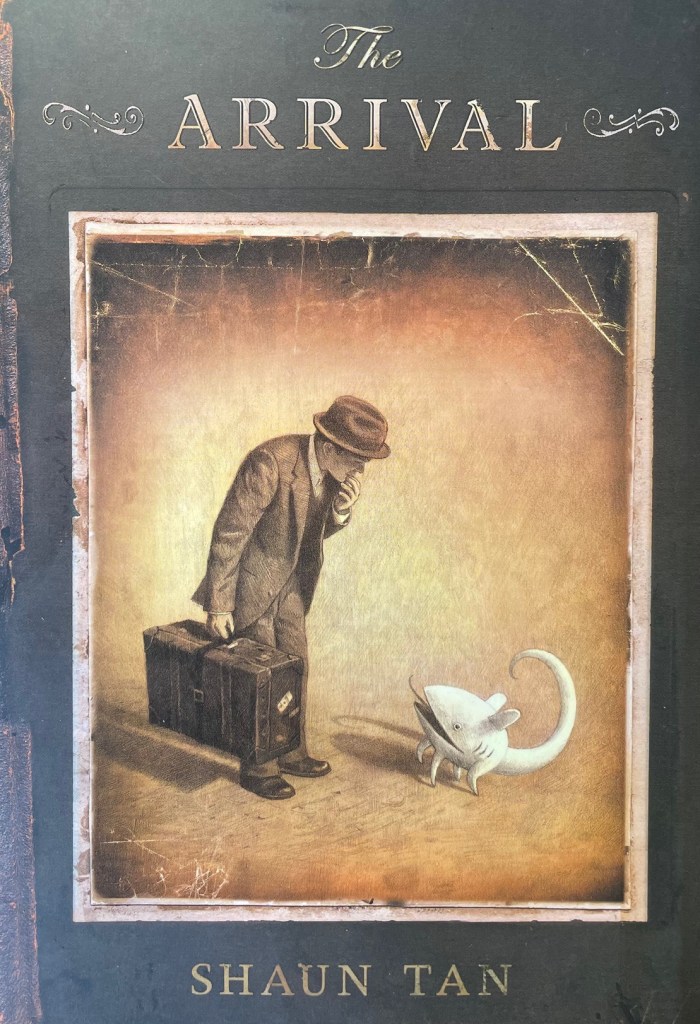
How Australian artist Shaun Tan uses surrealism to root readers in the immigrant perspective.
Picture Credit
From Shaun Tan’s The Arrival (2006). Taken by me with my phone camera.
I was given The Arrival (2006) as a birthday present by my aunt and uncle, maybe a month ago. This article is dedicated to them both for introducing me to this piece.
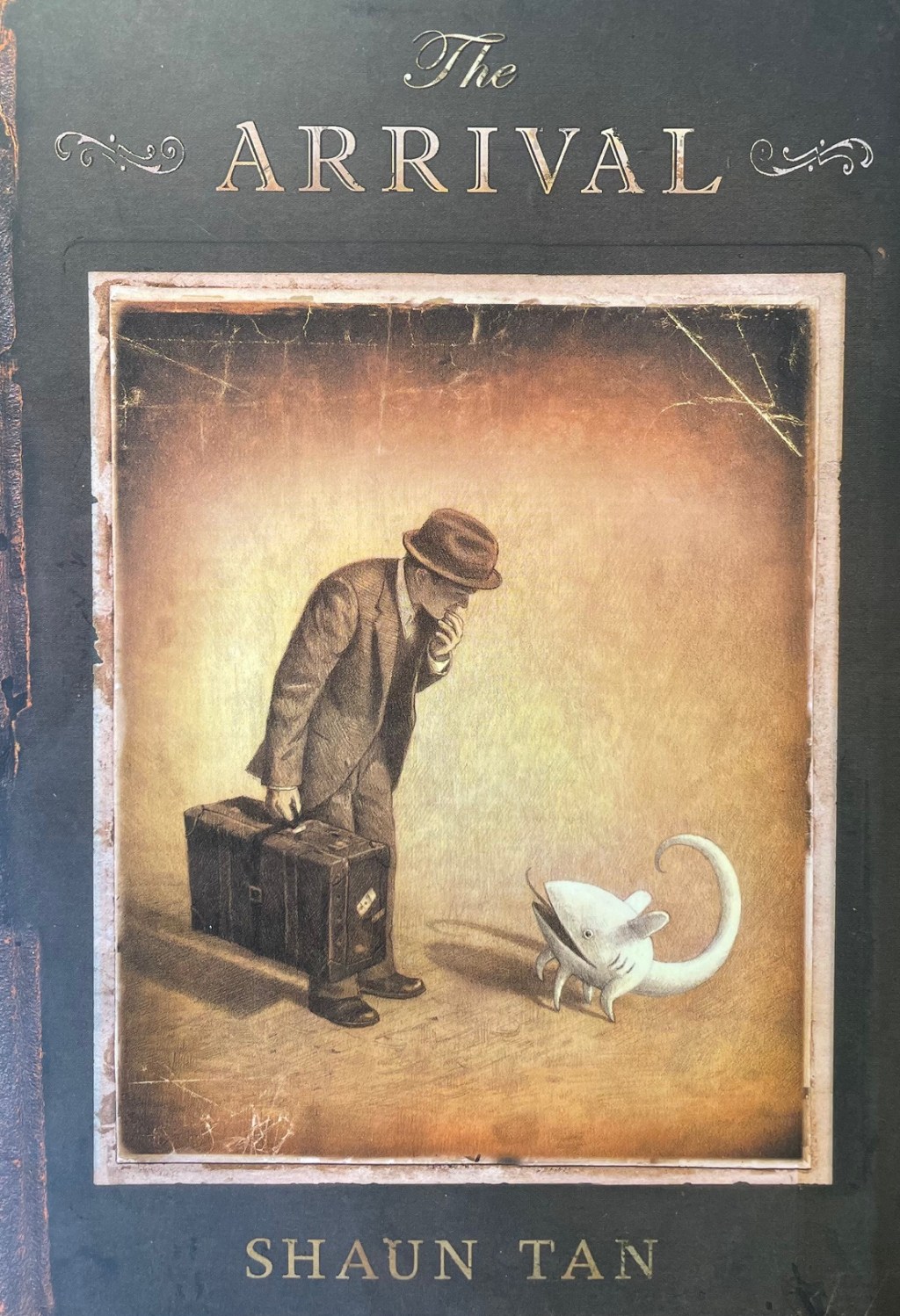
The Arrival is a graphic novel about an immigrant. It was created by Shaun Tan, an Australian artist, writer, and illustrator, and published in 2006. One of the key draws of the work is its focus as a wordless comic, in that there is no dialogue. The story is told entirely visually, through Tan’s art, and Tan does a phenomenal job of this. Of course, though, there are far more layers to this piece.
Reading The Arrival, its themes and message have struck me as profoundly important, particularly in our modern discourse over immigration. There has been a growing tendency to demonise immigrants and diminish their experiences; Tan asks us, instead, to treat the immigrant with empathy, understanding, and patience.
Beyond its thematic approach, The Arrival truly is a testament to Tan’s mastery of the medium of comics. Everything, down to panel size and panel layout, is painstakingly calculated. Tan’s use of smaller panels for tension and distance is phenomenally done, to the point where I felt the emotions he was trying to convey, even without words. The comic’s position as wordless is of particular note, emphasising the visuals of Tan’s artwork.
And what marvellous artwork it is!
Picture Credit
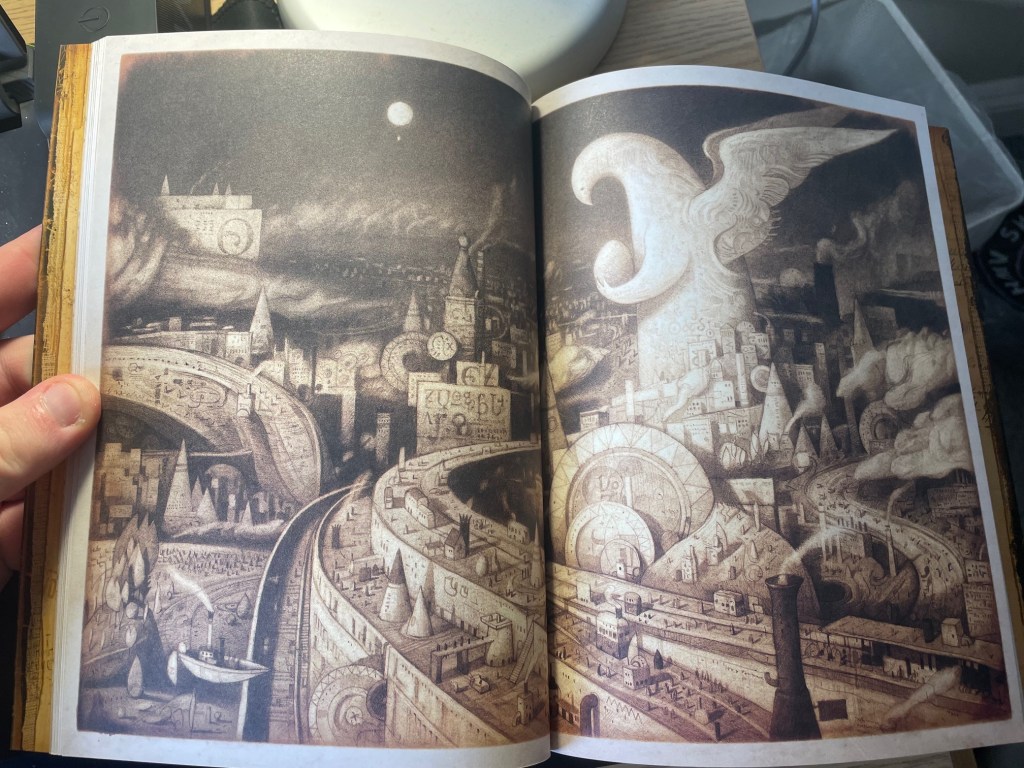
From Shaun Tan’s The Arrival (2006). Taken by me with my phone camera.
Tan’s style is surrealist, with elements of romanticism, grandiosity, and a level of playfulness that makes his world feel very real. There is a roughness to it, almost a scratchiness, alike to how an old photograph might have looked; this lends a level of texture and tactility to the art. As I run my fingers over it, I can almost feel the materials, even if what I am actually feeling is just glossy, comic book paper. With the words removed, Tan allows us to fully immerse ourselves in the spectacle of his art. The common phrase “every panel is like a painting” often can seem quite trite; I have yet to see a work this phrase describes more aptly than The Arrival.
This article is not a conventional review by any means. It will largely leave much of the bulk of the story alone, unexplored, for you to discover on your own, should you wish to. (Though there will naturally be some spoilers throughout). I wanted to focus on the themes that Tan highlights and his emphasis on the immigrant perspective. I also want to highlight how his surrealist art – beautiful as it may be – serves a deeper purpose for the story beyond simply an aesthetic appeal. This outlandish surrealism becomes a very vivid and affecting representation of the immigrant experience.
I do want to preface this by making clear that I am not an immigrant and that I am not professing myself as an expert on the immigrant experience. I simply think that this work is important, particularly empathetically, and I wish to contribute my own thoughts to its discourse. Hopefully, you may find some resonance and some value in my idle ramblings, and I do encourage you to check out Shaun Tan’s work (visit his website: https://www.shauntan.net/).
The rest of this article is structured along four main themes:
- The White Monster (who I shall affectionately name “Grubbin”)
- How The Arrival portrays push factors of immigration
- The Arrival’s surrealist setting
- The significance of the ending of The Arrival (this section has the most spoilers – you have been warned.)
The White Monster (Grubbin)
Picture Credit
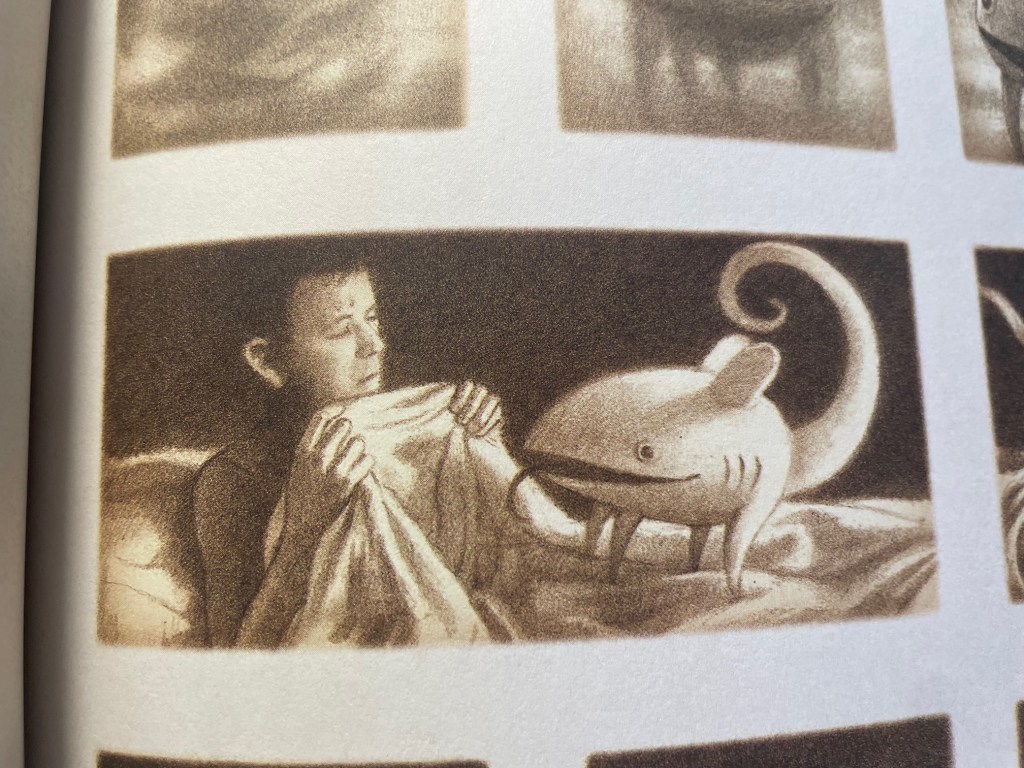
From Shaun Tan’s The Arrival (2006). Taken by me with my phone camera.
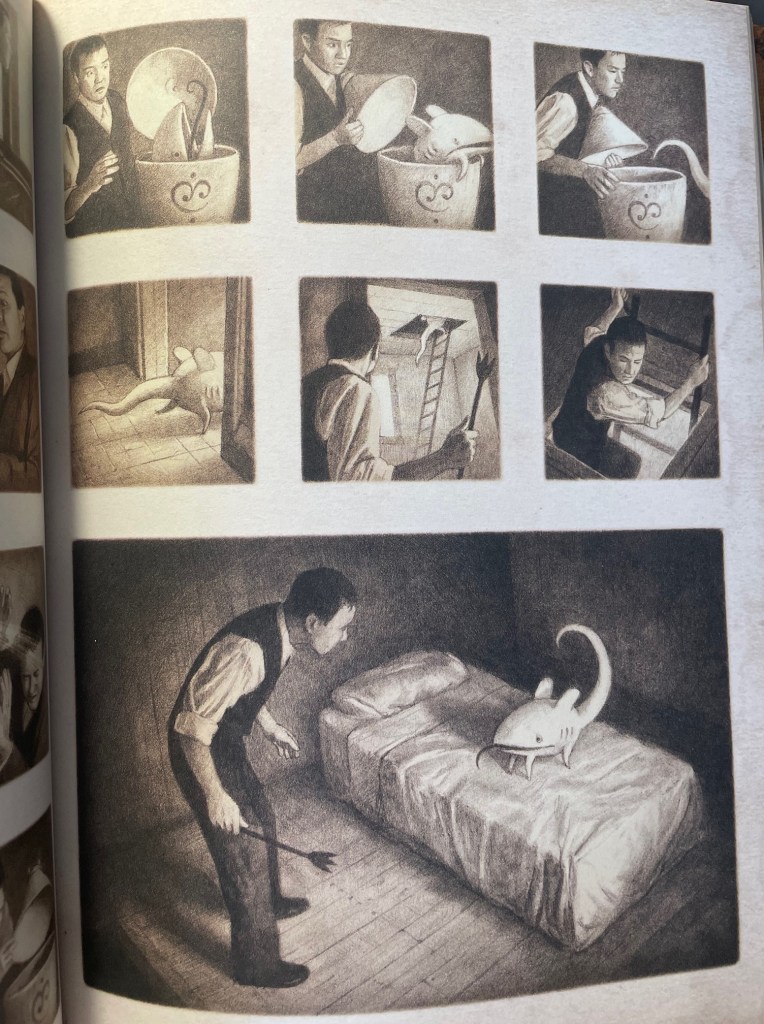
Grubbin is introduced fairly early in the story, shortly after our Main Character arrives at the New Place. They are introduced hiding in what appears to be a large pot. What ensues is a brief chase into the Main Character’s bedroom.
I am not quite sure what “level” of sentience Grubbin has. They appear quite doglike in some regards, though also are treated with a level of autonomy and independence not traditionally reserved for our pets. There is also the key point in that they lack a leash or collar, or anything that really screams, “pet.” For the sake of this article, I will largely consider Grubbin as their own autonomous individual.
Thematically, Grubbin is vital to the story. They are not just simply a cute little monster that our Main Character befriends. They serve as the first “native” friend of our Main Character, highlighting the importance of acceptance and companionship to the immigrant experience. Grubbin serves as a “light” for our Main Character, a little bit of hope that he can settle in and integrate into the New Place.
Picture Credit
From Shaun Tan’s The Arrival (2006). Taken by me with my phone camera.
There is a weirdness to Grubbin as well, that is particularly important: we meet them hiding in a pot, and as I mentioned, there is ambiguity over whether Grubbin is just a pet or something more. Not only does this tie into the general surrealist themes of the setting (which will be explored in more detail below), but it also highlights a key theme of friendship, one that is not solely applicable to the immigrant experience, but to anyone navigating unusual or unfamiliar environments. Friends appear in unlikely places and in unexpected forms; you just need to be open to them.
Grubbin also serves as a symbol of the Main Character’s story arc in miniature. The Main Character begins as an immigrant to the New Place, scared and overwhelmed; by the end, he has integrated into the New Place. Similarly, Grubbin begins the story as the Main Character’s friend and eventually is integrated into his family.
How The Arrival Portrays Push Factors of Immigration
One of the recurring themes, or motifs, of The Arrival is the idea that every immigrant has a past. That is not to say that every immigrant necessarily has a bad past, though it is these sorts of pasts that the narrative highlights. There are two broad categories of factors influencing immigration: push factors (the reasons for leaving a place) and pull factors (the reasons for going to a place).
Contemporary discourse, particularly focussing on Western immigration, likes to concentrate on pull factors, the reason why someone may choose to come to Western countries such as the United Kingdom. Using the UK as an example, popular pull factors include NHS, rights and freedoms granted by the UK government, as well as economic factors such as higher wages and more consistent employment. However, discourse can sometimes neglect to acknowledge or fully appreciate the influence of push factors such as war, oppression, or poor economic conditions. The Arrival largely focusses on these push factors – much to its own benefit. For instance, there are three main push factors Tan identifies:
- Oppressive regimes (as represented by reaching tentacles; Tan discusses this on his website)
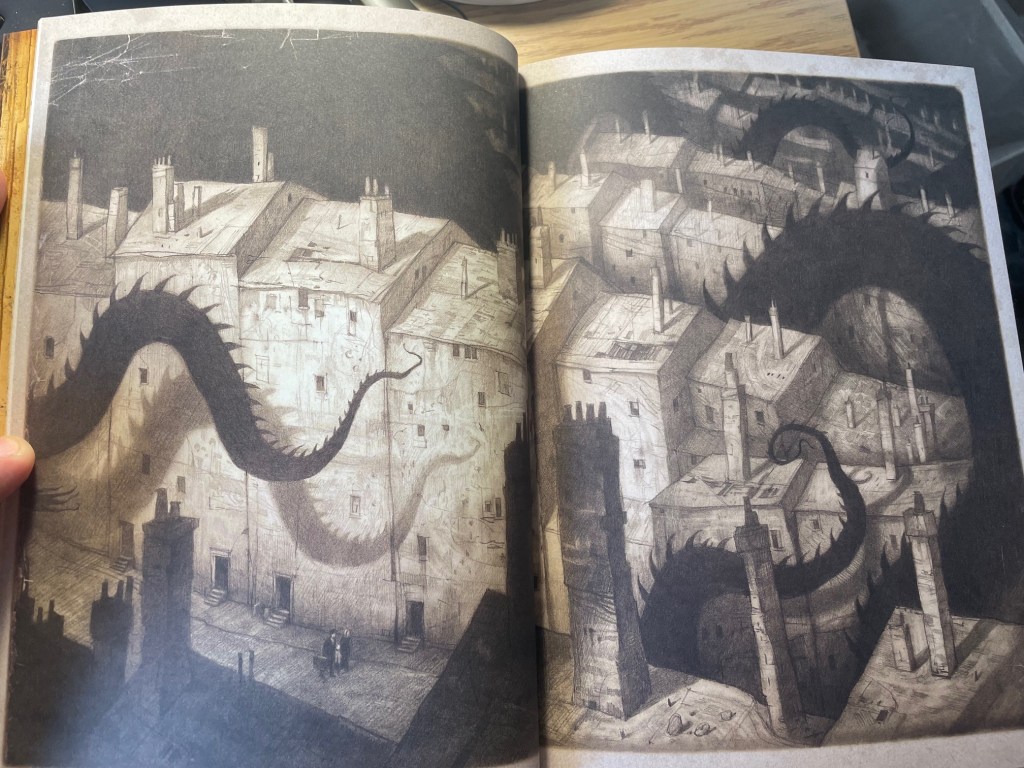
Picture Credit
From Shaun Tan’s The Arrival (2006). Taken by me with my phone camera.
- Economic conditions (as represented by the poor conditions of the massive Factory)
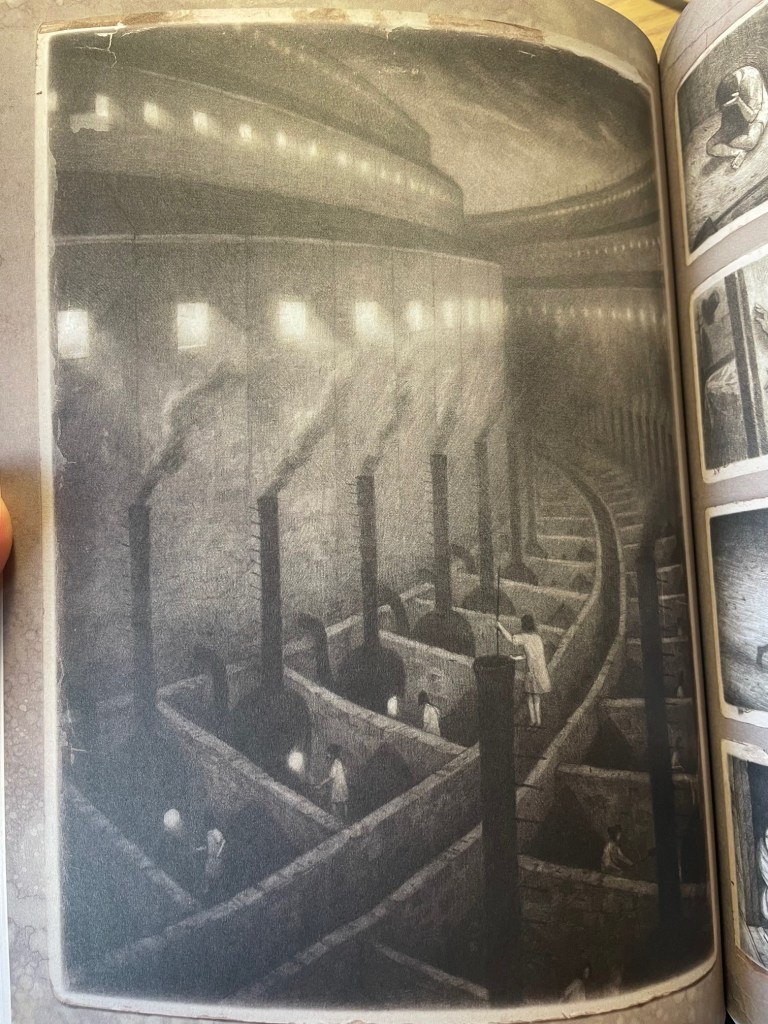
Picture Credit
From Shaun Tan’s The Arrival (2006). Taken by me with my phone camera.
- War (as represented by the Attack of the Big People)
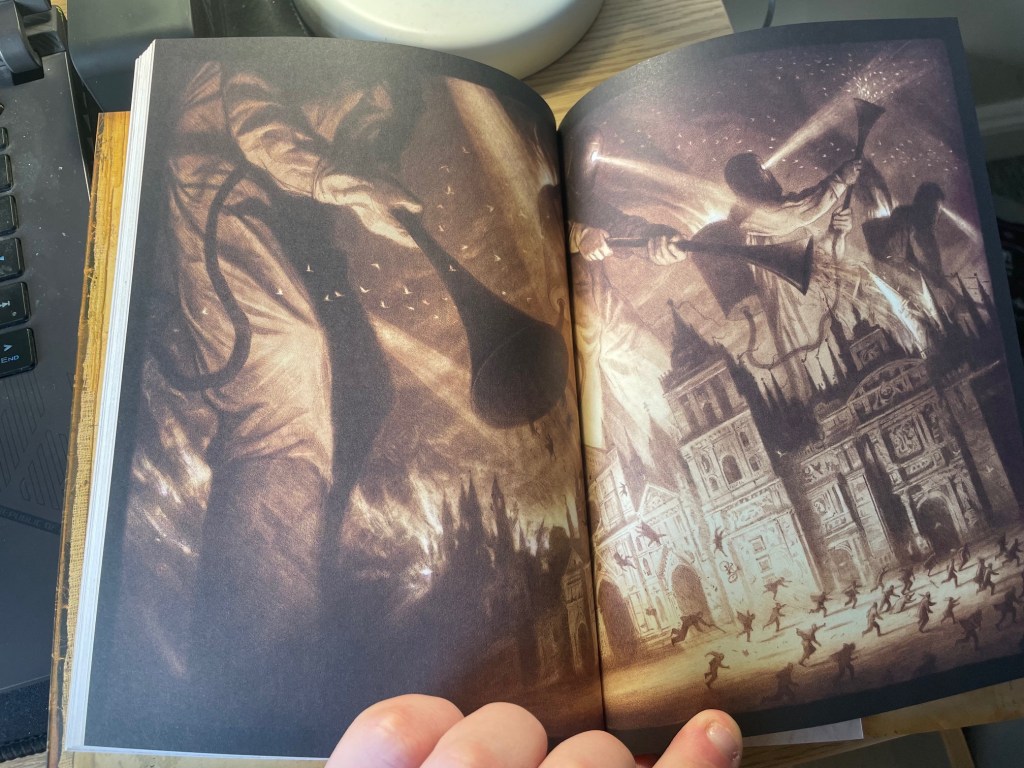
Picture Credit
From Shaun Tan’s The Arrival (2006). Taken by me with my phone camera.
This focus on push factors does a number of things. For one, it allows us to empathise with these immigrants and their struggles. For two, it breaks the myth of the superior place. Countries that are seen as “desirable” places for immigrants to travel to may perceive themselves as superior over the places in which these immigrants may come from; pull factors, thus, serve as evidence for their own superiority.
Finally, this focus on push factors alters our perceptions of immigration. Popular discourse likes to proudly declare immigrants as “invasive”, whereas Tan seems to lean more towards “desperate.” The immigrants in his work are not seeking to topple some Western paradise, but are simply seeking escape – for both themselves and their families. In this way, he asks us to empathise with immigrants and their struggles.
While I do believe that the work might have become more balanced in general had Tan included pull factors in his narrative, this would not necessarily have been to the betterment of the work as a whole. Tan’s thematic tendencies err towards respect and empathy for immigrants, and placing focus on pull factors may have diluted this theme.
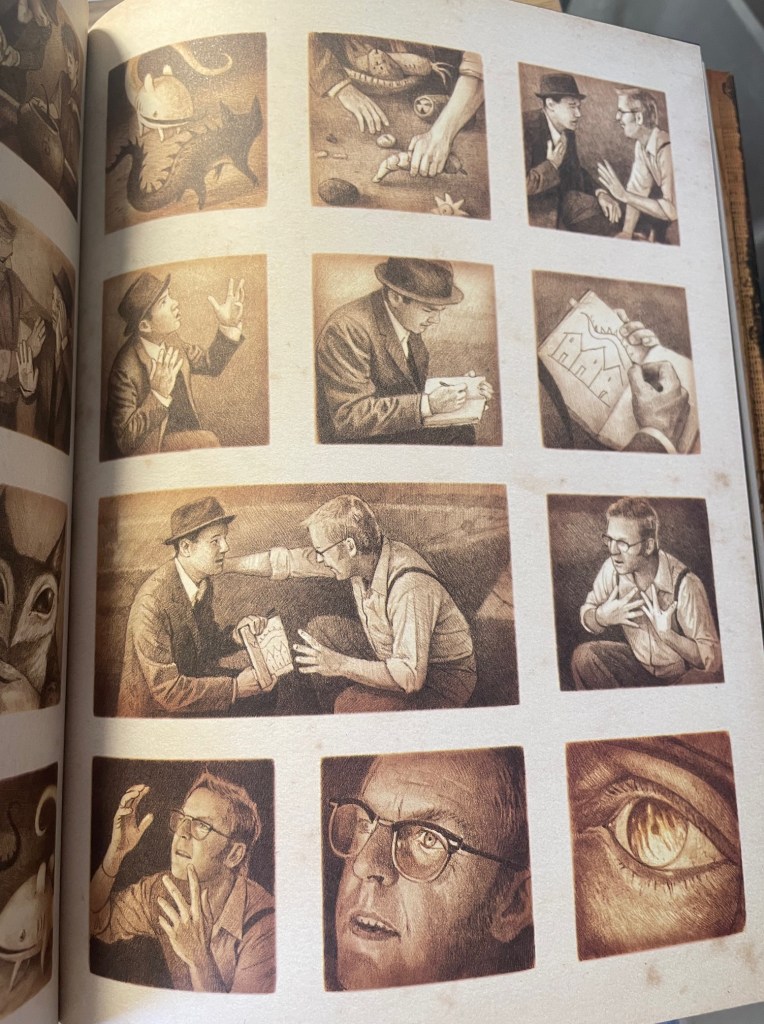
Lastly, one of the more interesting parts of the narrative – and personally, one of my favourites – is the moment when our Main Character draws the tentacle for another immigrant. In particular, I like how the two characters are therefore shown to have a mutual understanding of themselves and their struggles. There is a theme of shared understanding, of collective experiences amongst immigrants. Though this man has faced different things to our Main Character (namely, the Big People), the two still have a large degree of empathy and shared experience. It is a small moment in the story, but one I really liked.
The Arrival’s Surrealist Setting
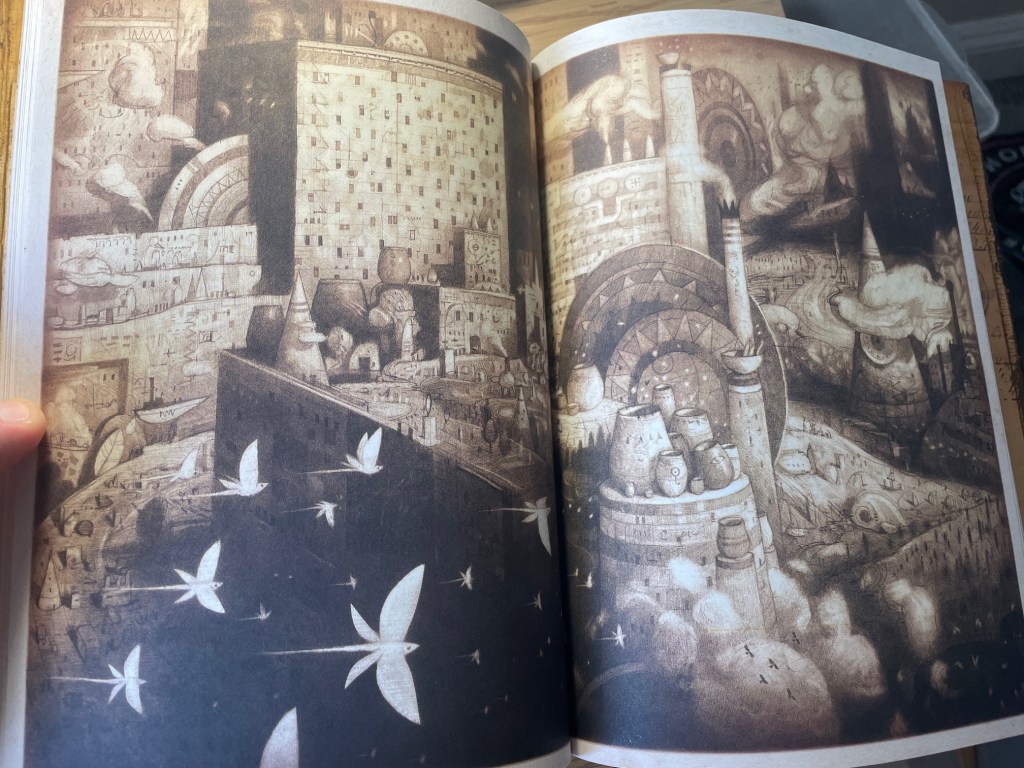
Picture Credit
From Shaun Tan’s The Arrival (2006). Taken by me with my phone camera.
What is phenomenal in this piece, which I haven’t quite experienced in other works, is how intrinsic the art is to the themes of the story. The art in comics is fundamentally entwined with the narrative; the story is reliant on the art to convey it well. Tan’s work takes this a step further. Not only is the artwork key in portraying the story, not only is it aesthetically pleasing, but it actively serves to strengthen the themes of the story.
Tan chose to portray the world(s) of The Arrival through a surrealist lens, a lens of heightened reality. This was a very effective choice. For instance, when we look at his double splash pages of the New Place, we see a romantic grandiosity to the work. The New Place is positioned in surreality as almost a heavenly place. A place of hope. But in the same breath, we see how startlingly different the New Place is to our familiar world. Tan’s artwork leans into this surreal difference, portraying the New Place as simultaneously heavenly and hopeful, while also being scary and overwhelming in its difference to our familiar world. In this way, he immerses us fully in the immigrant experience.
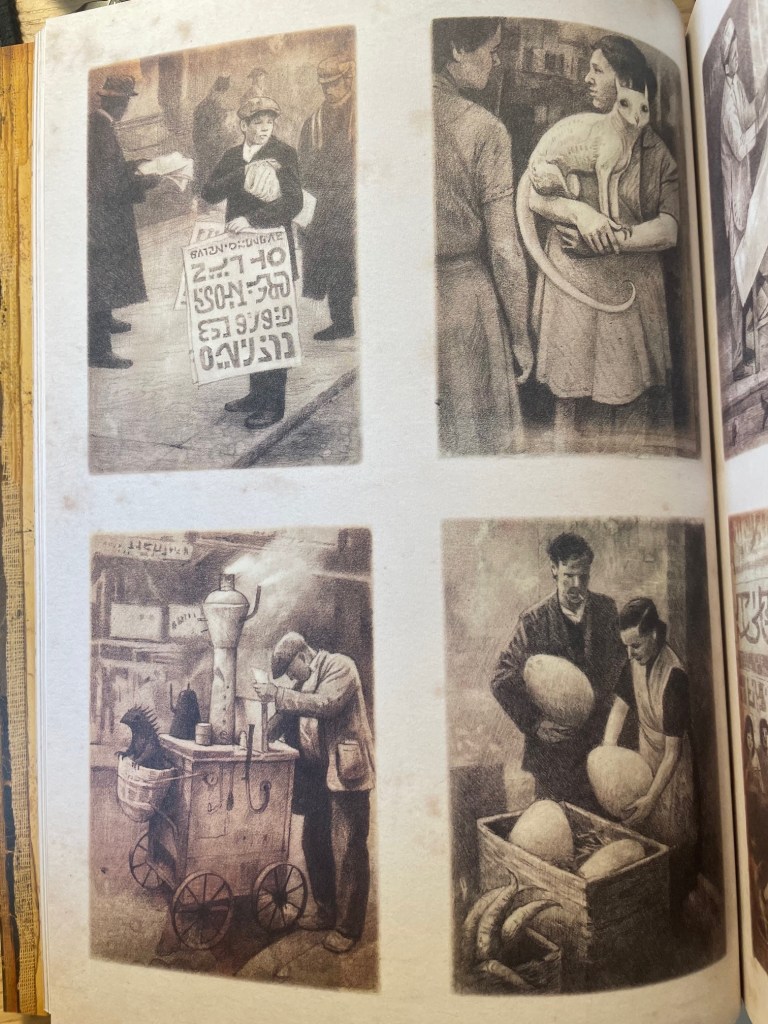
Picture Credit
From Shaun Tan’s The Arrival (2006). Taken by me with my phone camera.
We see this “surreal difference” seeping into every aspect of the New Place. In every scene, and in most panels, there is always something happening, something new and exciting. But because of this surreal difference, there is an apprehension, a nervousness to us, as readers, when we survey these scenes. We are not quite sure what is going on; it looks somewhat familiar, but distorted. Such is a similar experience to how our Main Character is feeling.
Tan develops this further by stripping away all dialogue in the story, making it a wordless comic. In comics, dialogue has often been used to convey what the art cannot, and by stripping this away, Tan strips away a certain degree of comfort and familiarity for the reader.
Tan’s use of comics as a wordless medium is not revolutionary. It has been done before, to great effect, in the past. However, in these past stories, in-world text (such as newspapers, maps, or notebooks) has been used as a substitute for dialogue, to give the reader information the art alone cannot convey. It serves as an easy way to bridge the communication gap, while still (technically) allowing the work to remain “wordless.”
The Arrival uses none of this. We see words, but the language is not our own, nor any Earthly language, even if it does seem familiar. This complements the themes of communication, particularly the struggles of communication, and again reinforces the immigrant perspective. Language barriers are a real issue for immigrants, and in portraying their story, Tan does not give us the comfort of any form of the English language in the story.
Like most surrealists, Tan does not stop to give us any explanations for how things work in the New Place – nor does he need to – and that adds to the charm. As we continue through the story, we gradually learn, implicitly, what things mean and how things work. We learn, implicitly, that this New Place is not so scary and can actually be quite cosy. In effect, our perceptions of the New Place are a mirror for how the Main Character feels, and how immigrants may feel upon arriving at their destination.
The Significance of the The Arrival’s Ending
Prior to the closing chapter, there is a bit of a withdrawal of Tan’s surrealism of the world, particularly as our Main Character finally reunites with the family he left behind at the beginning of the story. We do get a return of the “hot air balloon”-like transport, and some weird bird things, but aside from that, this reunion scene seems quite normal compared to the rest of the work. Which definitely works in its favour, in terms of garnering an emotional response.
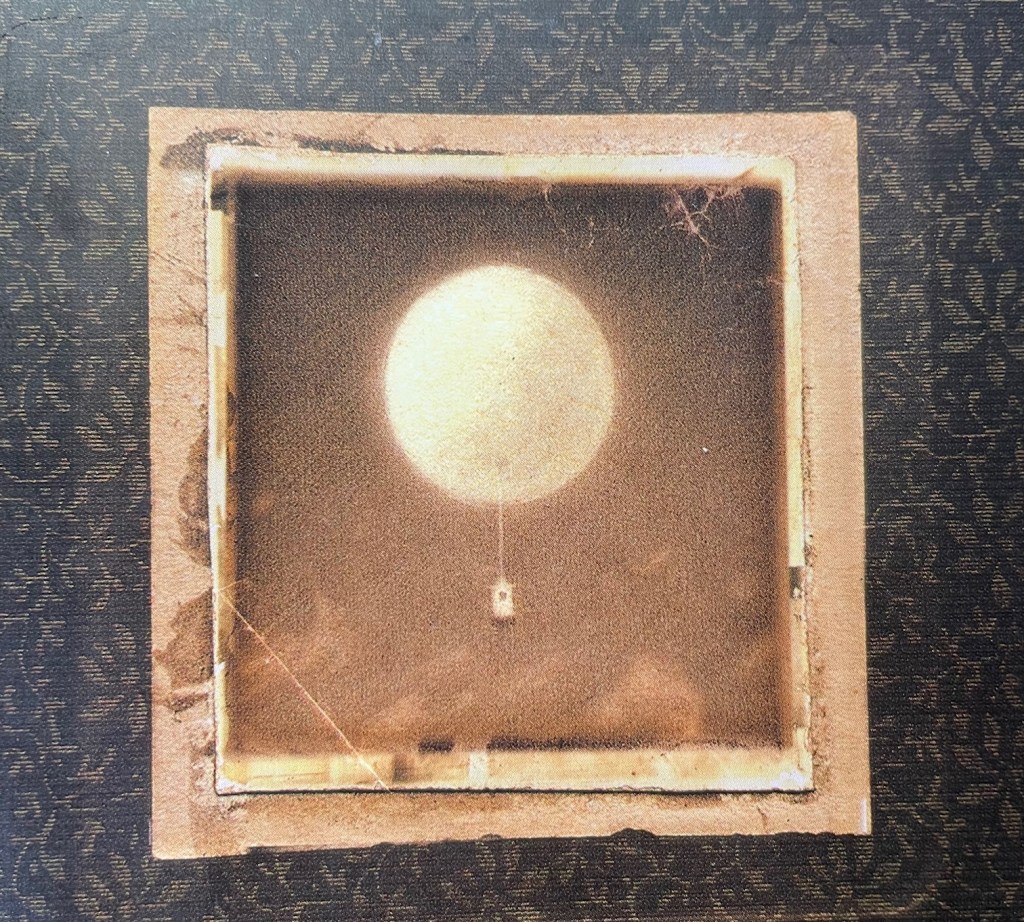
Picture Credit
From Shaun Tan’s The Arrival (2006). Taken by me with my phone camera.
How Tan constructs this reunion sequence is stunning. There are lots of things here that budding artists can take away. I will just go into a few of them now.
Tan builds tension in the preceding pages through the Main Character’s focus on the sky and through using smaller panels, which build a sense of movement and urgency into the scene. He emphasises this tension in his use of page and page positions. We see our Main Character looking in the distance at something in the sky, but it’s not until we turn the page that we see the “hot air balloon”-like transport, and then we understand: someone is coming. The tension then ramps up with interspersions between the perspectives of our Main Character and his wife and daughter who are on the transport.
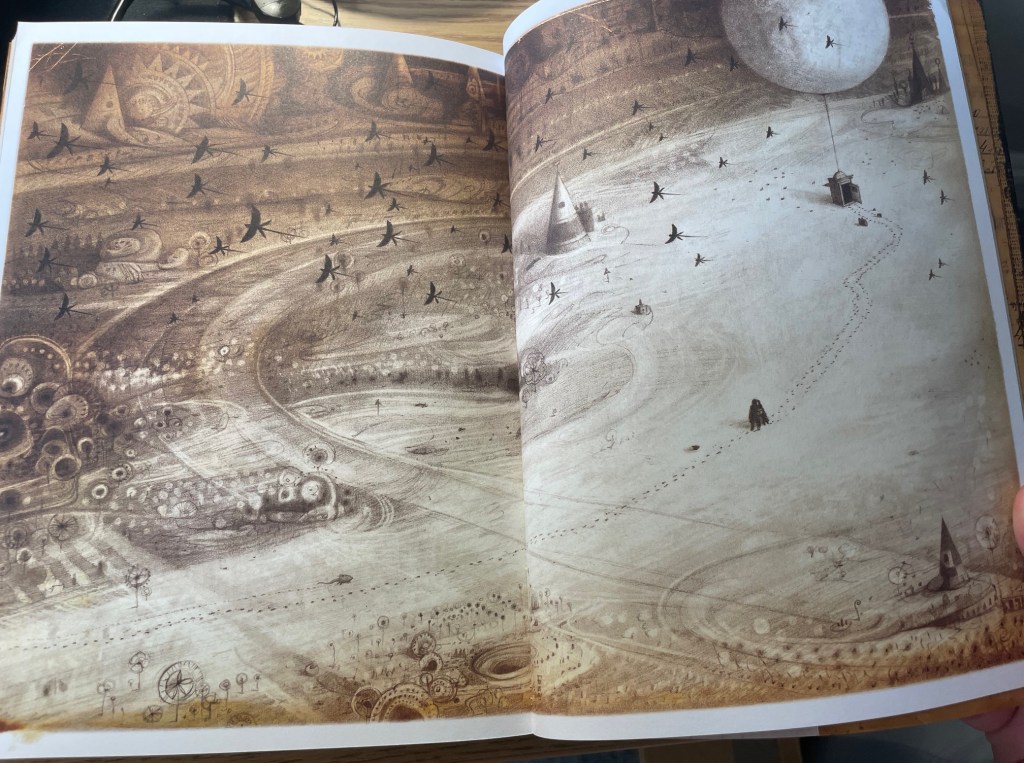
This makes the final reunion very cathartic. Tan capitalises on the tension he has built up, making the reunion a double splash page. The reunited family are small, in the centre; the trails of footsteps behind them emphasise the distances they have come. I also really liked Tan’s inclusion of Grubbin, the little white monster, as they chase the Main Character, happy to join their new family. It is a very nice moment, a pinnacle of visual storytelling, and one that really surprised me in how emotionally affecting it was.
Now I have covered that, let us turn to the actual final chapter of the story. This final chapter is a mirror of the first chapter in many interesting ways, and it is a wonderful expression of hope and optimism.
The ending of The Arrival is quite interesting, particularly when looking at the surrealism in Tan’s art. It almost feels…less surreal. Even though the style has not changed and even though the New Place is just as weird and wacky as ever. I think it ties back to the point I made in the previous section, where as the story proceeds, we readers become more comfortable and more familiar with the surreal world that Tan has introduced us to.
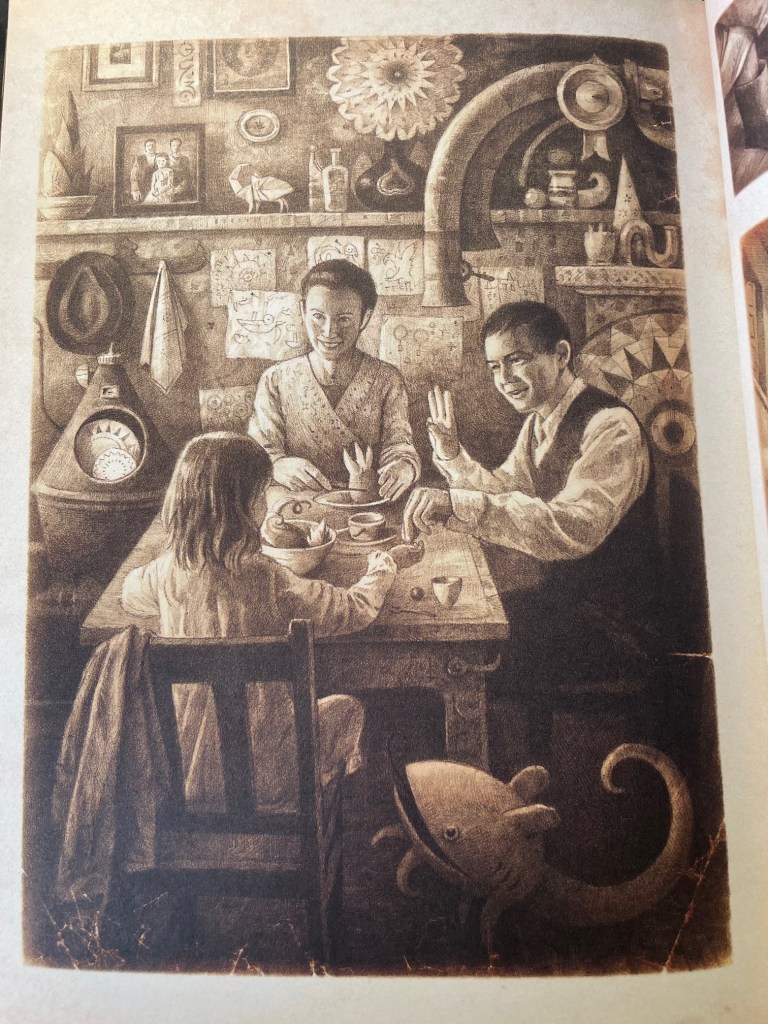
This theme of familiarity is present throughout the final chapter, as we are shown how the family has integrated into the New Place. We see them happy, compared to the sad faces the story opens with. We see, also, how Grubbin has been integrated into the family; those origami Grubbins are incredibly cute.
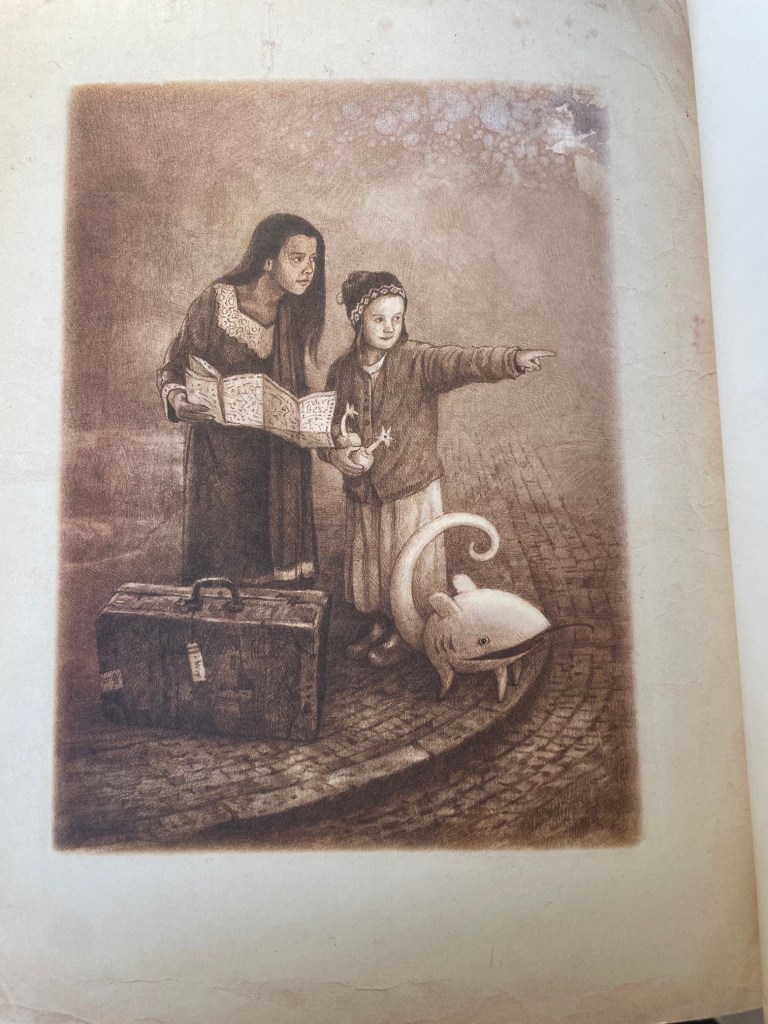
There is a sense that the family has successfully integrated into the New Place, particularly when looking at the final panel of the story.
Picture Credit
From Shaun Tan’s The Arrival (2006). Taken by me with my phone camera.
This shows the Main Character’s daughter serving in a “native” role, directing a newcomer (potentially a fellow immigrant) over where she needs to go.
This is a highly optimistic ending that works well within the story, though it may be too optimistic to transfer thematically into real life. Immigrants may have difficulty with integrating, while others may simply choose not to integrate. The actual process of integration is itself a tricky debate. Integration can veer towards assimilation, which can cost immigrants their own unique cultures and identities; likewise, non-integration can build walls between native and immigrant communities, sparking division and foreshadowing problems to come. The answer to this debate is certainly a tricky one, and it is not one I feel qualified enough to provide.
Conclusion
Ultimately, Tan’s The Arrival is a work of surprising simplicity and depth. Reliance on visuals alone strips away much of the comfort of words and letters, allowing him to capture a truly powerful narrative in his story. His use of surrealism extends beyond mere texture or gimmicks; it is justified by both its aesthetic appeal and how the surreal nature of the New Place alters our perceptions of it. This is a charming book, with a powerful story to tell, and a story which encourages empathy and understanding for our fellow human beings and highlights the difficulties of integration amongst immigrants. The topic of immigration is a polarising one, in our modern world, and as Tan reminds us, immigrants are people coming from somewhere as much as they are people arriving somewhere new.
This is the first work by Tan I have read, and I am surely blown away. There is no denying that he is a true master of his craft, and I will definitely have to check out some of his other stuff. He recently published, earlier this year, Hometown, his first long-form graphic novel since The Arrival. Again, do check out his website (https://www.shauntan.net/).
Thank you for reading!
—
If you enjoyed this post, please be sure to like and leave a comment below. All support is gladly appreciated!
Additionally, if you would like to keep up to date with this website and my writing, please subscribe below. Follow me on Wattpad (SecretWriter575) and on Instagram (writer_ec_23).
MORE POSTS:
- (Previous) What Can Writers Learn From George Lucas’ Star Wars Films?
- Typing Galaxies Blog Homepage
- Stories Homepage
LATEST POSTS:
- Creating Meaning in Wordless Images: Shaun Tan’s Surrealist Portrayal of the Immigrant in The Arrival
 How Australian artist Shaun Tan uses surrealism to root readers in the immigrant perspective. I was given The Arrival (2006) as a birthday present by my aunt and uncle, maybe a month ago. This article is dedicated to them both for introducing me to this piece. The Arrival is a… Read more: Creating Meaning in Wordless Images: Shaun Tan’s Surrealist Portrayal of the Immigrant in The Arrival
- A Dark Vision
 Inspiration: “The streets are extended gutters, and the gutters are filled with blood, and when the drains finally scab over, all the vermin will drown.” (Rorschach in Watchmen (1987) by Alan Moore and Dave Gibbons). There’s a dank smell in the air. So strong, even the rain can’t wash it… Read more: A Dark Vision
- The Seven
 A random story (or, part of a story) I found… I was just randomly flipping through a notebook of mine, when I came across this little story from a year or two ago. I haven’t read or edited it; this is me literally transcribing word for word and discovering (the… Read more: The Seven
- Wildwater (Amended Version)
 Full Amended Version of Wildwater: Rise of the Orr’un… Please see below for the Amended Version of this story. The story itself is largely unchanged from the original version, only with additional references to the Sovenian Dynasty, the Southern Fringe, and the Milithron Galaxy in which the story is set.… Read more: Wildwater (Amended Version)
- The Tyranny of Unkillable Gods
 The only thing an Angel fears is Death… This is the first of my short stories intended to expand on the world established in another story, Corruption Of Mortality. My writer-friend and I are planning a short story anthology, and this will be one of my contributions to the anthology.… Read more: The Tyranny of Unkillable Gods


Leave a Reply